Short answer: In California, any roofing job of $1,000 or more in labor and materials must be done by a contractor licensed by the CSLB, usually with a C-39 roofing classification. Look up the license number on the CSLB website, confirm it is active, check the bond and workers’ compensation status, and get a written contract before any work starts.
Quick checklist
- Get the contractor’s license number and look it up on the CSLB website.
- Confirm the license is active and includes the C-39 roofing classification (or a general building license for roofing within a larger project).
- Check that the business name on the license matches the name on the bid.
- Check the bond and workers’ compensation status shown on the license record.
- Ask for proof of liability insurance.
- Get a written contract with scope, price, payment schedule and start date.
- Keep the deposit within California’s legal limit.
The C-39 license requirement
The Contractors State License Board (CSLB) licenses contractors in California. A contractor must be licensed for any job where labor and materials together total $1,000 or more. Roofing has its own classification, C-39. A roofing contractor with a C-39 has passed the state’s trade and law exams, shown experience and filed a bond with the state.
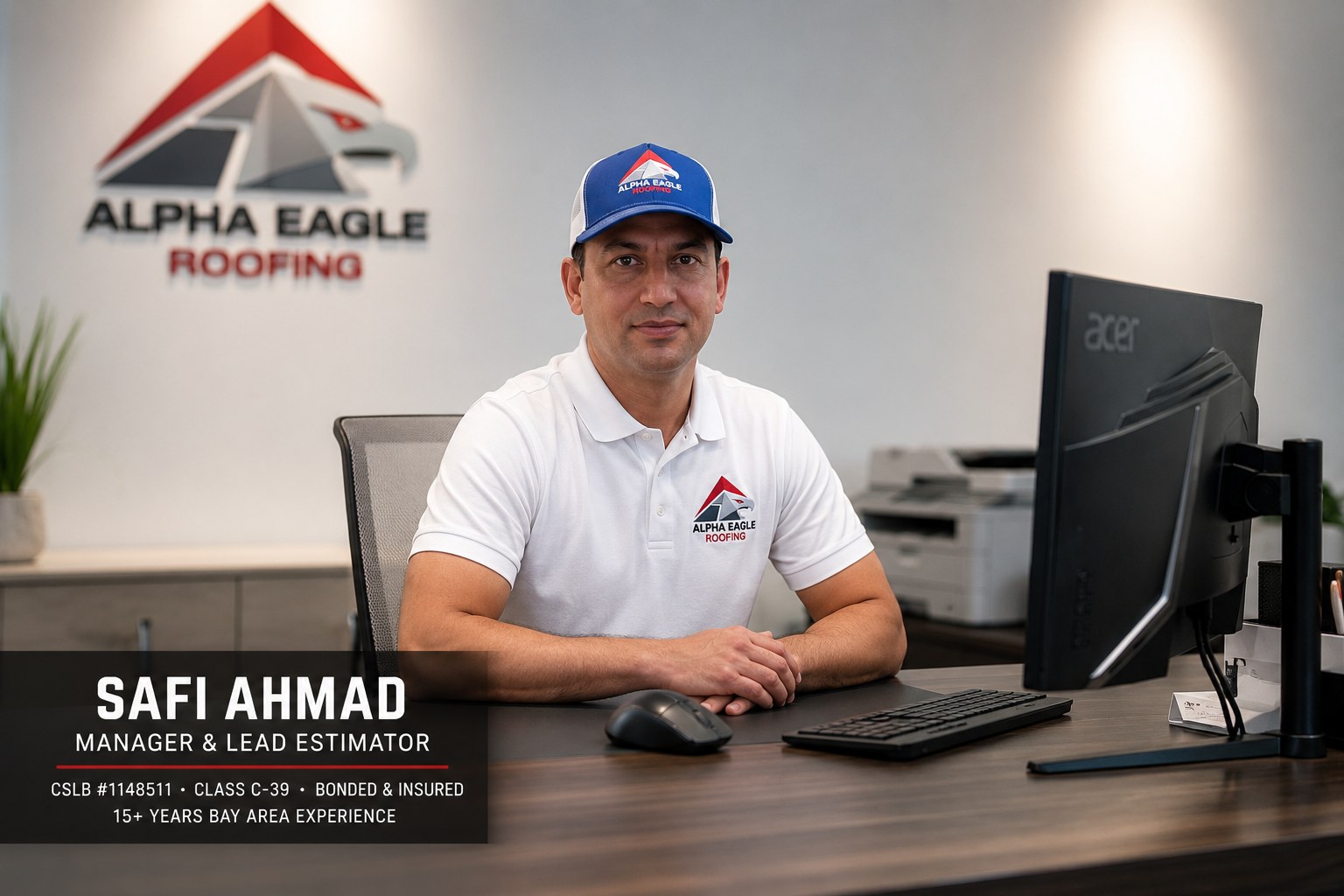
Alpha Eagle Roofing holds CSLB license #1148511, Class C-39. We put the license number on every estimate and contract, as the law requires.
How to verify a license on the CSLB website
The CSLB site has a free license lookup. Search by license number, business name or personal name. The record shows:
- Whether the license is active, expired or suspended.
- The classifications the license covers.
- The contractor’s bond and bonding company.
- Workers’ compensation coverage, or an exemption if the contractor claims to have no employees.
- Any public complaints or disciplinary actions within the reporting rules.
If a contractor has employees on your roof but the license shows an exemption from workers’ compensation, ask about it. Roofing is physical work, and an injured uninsured worker can create problems for a homeowner.
Red flags for unlicensed work
- No license number on the bid, business card, truck or ads.
- A license number that belongs to someone else, or a business name that does not match.
- Requests for a large deposit, cash only, or payment before materials arrive.
- Pressure to sign immediately with a “today only” price.
- Offers to skip the permit to save money.
- A price far below every other bid with no clear explanation.
- No written contract, or a one-line contract with no scope.
California law limits the down payment on a home improvement contract to $1,000 or 10 percent of the contract price, whichever is less. A contractor asking for more up front is either unaware of the rule or ignoring it.
Questions to ask before signing
| Question | Why it matters |
|---|---|
| Will you tear off the old roof or overlay it? | Tear-off lets the deck be inspected; codes limit overlays |
| How do you handle damaged decking? | Avoids surprise charges after tear-off |
| Will you replace flashing or reuse it? | Reused flashing is a common leak source |
| Who pulls the permit? | Permitted work protects you at sale and claim time |
| Who will be on my roof, employees or subcontractors? | Affects supervision and insurance |
| What does your workmanship warranty cover, and for how long? | Separate from the manufacturer warranty |
| How do you document the job? | Photos show what is under the finished roof |
For more on reading a contractor’s paperwork, see how to read a roofing bid.
Storm chasers and door-to-door offers
After a big atmospheric-river storm, some out-of-area crews go door to door offering quick repairs or promising that insurance will pay for a new roof. Some are legitimate, many are not licensed in California, and some disappear after taking a deposit. Be careful with anyone who:
- Shows up uninvited right after a storm.
- Offers to “handle everything” with your insurance or asks you to sign a document giving them rights to your claim.
- Offers to cover or waive your deductible, which can be a form of insurance fraud.
- Has out-of-state plates and no local address.
Verify the license before letting anyone on your roof. Our insurance claims page explains how we document storm damage for homeowners, and our post on emergency roof repairs covers what to do right after a storm.
Checking insurance and bonding
A contractor’s license bond is required by the state, but it is limited and is not the same as insurance. Ask for a certificate of liability insurance and, if the contractor has employees, proof of workers’ compensation. You can ask the insurer to confirm the policy is current. Make sure the names on the insurance certificate, the license and the contract all match.
What the written contract should include
California sets rules for home improvement contracts, and a professional roofer’s contract will follow them. At a minimum, expect to see:
- The contractor’s name, business address and license number.
- A description of the work and the materials, specific enough that you could compare it with another bid.
- The total price and a payment schedule, with the down payment within the legal limit.
- Approximate start and completion dates.
- Your right to cancel notice, which applies to most home improvement contracts.
- How change orders will be handled, in writing.
- Required notices about mechanics liens and the CSLB.
If any of these are missing, ask for a revised contract before you sign. A contractor who resists putting the details in writing is telling you something.
Salespeople and who you are dealing with
California requires people who sell home improvement contracts on behalf of a contractor to be registered with the CSLB as home improvement salespersons. Ask who will actually estimate and supervise your job. With us, your estimate comes from a senior estimator who looks at the roof, and the same team stays involved through the job.
Why it all matters
Hiring a licensed, insured roofer protects you if something goes wrong, keeps the work inspectable and makes the roof easier to defend at sale or claim time. If you want to see how we work, look through our project gallery, read our customer reviews or learn why homeowners choose Alpha Eagle. We work across the Bay Area, including roof repair in San Francisco and San Mateo.
Frequently asked questions
Do I need a licensed contractor for a small roof repair?
If labor and materials total $1,000 or more, California requires a licensed contractor. Most roof repairs reach that threshold.
What is a C-39 license?
C-39 is the CSLB classification for roofing contractors. It covers installing and repairing roofing systems.
How can I tell if a roofer has workers’ compensation?
The CSLB license lookup shows the workers’ compensation status. You can also ask for a certificate and confirm it with the insurer.
Is a contractor’s bond the same as insurance?
No. The license bond is required by the state and is limited. Liability insurance and workers’ compensation are separate protections you should ask about.
Want to work with a licensed C-39 roofer? Request a free inspection and written estimate, or call (415) 410-7917.