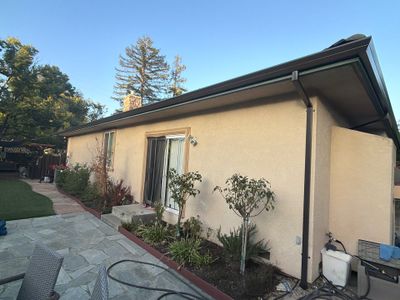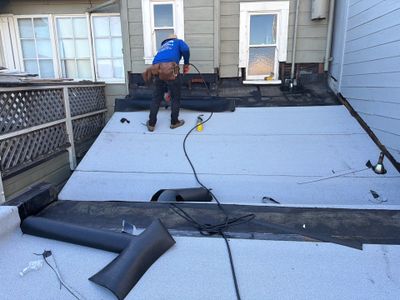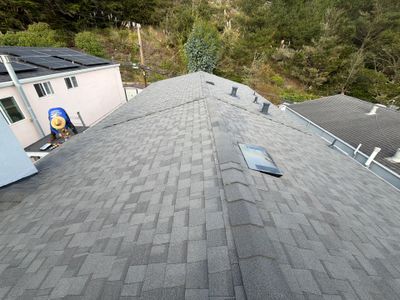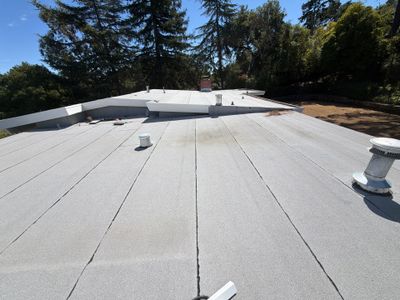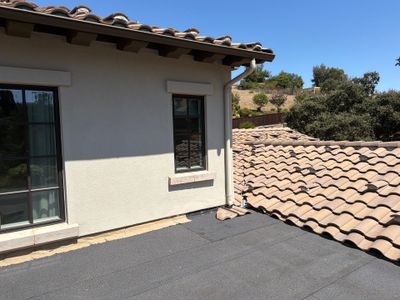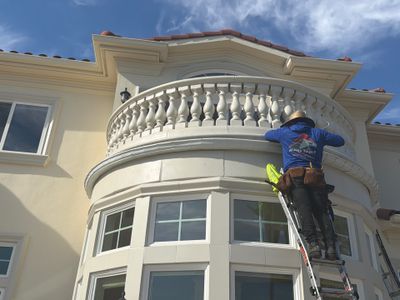
Most roof leaks enter at flashing, penetrations or valleys, often several feet from the stain on your ceiling. Alpha Eagle Roofing traces the actual entry point from the attic and the roof surface, repairs it with the right flashing and materials, and confirms the fix. If a repair would only be throwing money at a roof that needs replacing, we tell you that instead.
Leak repair at a glance
- Where leaks start
- Flashing, penetrations and valleys, often several feet from the ceiling stain
- Typical visit
- One visit once the leak is traced; hard-to-find leaks may need a water test
- In the rain
- The area is secured first; the permanent repair follows when the roof is dry
- Permit
- Small repairs often need none; larger repairs and partial reroofs often do
- License
- CSLB #1148511, Class C-39 Roofing Contractor
Who this service is for
- Homeowners with a ceiling stain, drip, or wet attic insulation.
- Owners of flat and low-slope roofs with ponding, blisters or leaking seams.
- Anyone with leaks around a chimney, skylight, wall, or vent pipe.
- Buyers and sellers with repair items from a home inspection report.
Signs you need a roof repair
Ceiling or wall stains
Brown rings or bubbling paint, often after wind-driven rain.
Drips or damp insulation in the attic
Look along rafters and around chimneys and vent pipes.
Missing, lifted or cracked shingles and tiles
Often after wind, tree contact, or someone walking on tile.
Loose or rusted flashing
At chimneys, skylights, walls and roof-to-wall transitions.
Cracked pipe boots
Rubber vent-pipe boots dry out and crack in the sun and are a very common leak source.
Ponding or blisters on a flat roof
Standing water that is still there days after rain wears out membranes and seams.
How we find and fix a leak
- Ask the right questions When does it leak, only in heavy storms or wind from one direction, and where does the water show up? Wind-driven leaks and slow seeps point to different causes.
- Start inside From the attic we follow the water trail upslope along the deck and rafters, because water travels before it drips.
- Inspect the roof above We check every likely entry point upslope of the stain: flashing, pipe boots, valleys, sealant, fasteners and damaged material.
- Water test when needed For hard-to-find leaks, we run controlled water on one section at a time, starting low and working up, with someone watching inside.
- Open only what is needed We remove the minimum material to expose the failure, photograph it, and show you what we found.
- Repair to spec New flashing, underlayment and roofing material installed correctly, not a smear of sealant over the symptom.
- Confirm and document We re-check the area, and the before and after photos go into your CompanyCam record.
Repairs we handle most often
These are the details that cause most of the leaks we trace on Bay Area roofs.
Chimney flashing
Step and counter flashing around the chimney, and a cricket (a small saddle) behind wide chimneys so water does not pool against the masonry.
Wall and stucco transitions
Where a roof meets a stucco or sided wall, the counter flashing has to tuck under the wall finish. Caulk alone fails within a few seasons.
Skylights
Skylight leaks are usually flashing or a failed seal, not the glass. We reflash, reseal, or recommend replacement when the unit itself has failed.
Valleys
Valleys carry the most water on the roof and collect leaves. We rebuild worn valleys with self-adhered membrane and new metal or shingles.
Pipe boots and vents
Cracked rubber boots replaced with new boots or metal flashings, and loose vents re-secured and flashed.
Tile repairs
Cracked or slipped tiles replaced, and underlayment repaired underneath where water has been getting through.
Flat and low-slope roof repairs
Flat roofs are common on San Francisco row houses, additions and commercial buildings, and they fail differently from sloped roofs.
Seams and blisters
Modified bitumen (torch-down) and TPO leaks usually start at seams, blisters, or edges. We cut out the failed area and patch with compatible material, heat-welded or torch-applied.
Drains and scuppers
Clogged or poorly flashed drains and scuppers cause ponding and leaks at parapets. We clear, reflash and, where possible, improve drainage.
Parapet walls
Parapet caps and the membrane turned up the wall are frequent leak points on flat roofs.
Patch, recover or replace
A few failed spots get patched. When the membrane is failing across the roof or the insulation underneath is wet, patching stops making sense and we will say so.
When repair stops making sense
We would rather tell you a roof needs replacing than sell you repairs every winter.
Repair is usually right when
The damage is isolated (one flashing detail, a few shingles, a pipe boot) and the rest of the roof has good life left.
Replacement is usually right when
Leaks show up in several places, shingles are losing granules across the roof, the deck is soft, or you are repairing the same roof every season. See roof replacement.
Emergency tarping
If water is coming in now, we can secure the area with a properly fastened tarp first and do the permanent repair when it is dry. See emergency roofing.
Roof repair near you, city by city
We repair roofs across San Francisco, San Mateo, Alameda, Contra Costa, Marin and Santa Clara counties. What leaks depends a great deal on where the house is and when it was built; these are the cities we are called to most often.
San Francisco
Roof repair in San Francisco is mostly flat and low-slope work on Victorians, Edwardians and Sunset row houses: parapet caps, wall joints and membrane seams.
The Peninsula
Chimney, dormer and valley flashing on 1910s to 1930s Craftsman, Tudor and Spanish revival homes under heavy trees accounts for much of our roof repair in Burlingame and roof repair in San Mateo. Closer to the ocean, roof repair in Daly City is a different job: fog, wind and salt air work on flat sections, ridge caps and the joint where a roof meets the neighbor's wall.
The East Bay
Roof repair in Oakland runs from ponding flat roofs behind parapets in East Oakland and around Lake Merritt to wind-lifted shingles and tired chimney flashing in the hills. Over the hills, roof repair in Walnut Creek more often means concrete tile, where the leak is worn underlayment beneath tile that still looks fine.
The South Bay
Roof repair in Sunnyvale and Palo Alto often involves Eichler flat roofs with failing seams or slow drains. Roof repair in San Jose leans toward tile underlayment and flashing, and on Saratoga's wooded hillsides it is usually valleys, skylights and chimneys; see roofing in Saratoga.
Roof types we repair
Asphalt shingles
Pros
- Individual shingles can be replaced
- Flashing repairs blend in well
Cons
- Very old shingles get brittle and break during repair
- Color match fades with age
Clay and concrete tile
Pros
- Damaged tiles can be swapped out
- Underlayment can be repaired locally
Cons
- Tiles crack if walked on carelessly
- Discontinued profiles can be hard to match
Metal
Pros
- Panels and trim are durable
- Most leaks are at fasteners or flashing and are repairable
Cons
- Repairs need matching metal and finish to avoid corrosion
- Exposed-fastener washers wear out
Flat roofs (TPO, modified bitumen, torch-down)
Pros
- Localized patches are effective when the membrane is sound
- Drainage fixes stop repeat leaks
Cons
- Patching a worn-out membrane only buys time
- Wet insulation underneath has to be found and replaced
Thanks. Your request is in.
We will text you to confirm.
Active leak? Our 24/7 emergency line is (415) 410-7917. Call now and we will prioritize your request.
Call (415) 410-7917What affects the cost
Two roofs of the same size can be very different jobs, so every price comes from an inspection, in writing. Your estimate is built from these factors:
- How hard the leak is to trace (a water test takes more time)
- Where it is: chimney, skylight, valley, wall or flat-roof seam
- Roof material, pitch and height, and access
- How much material has to come off to reach the failure
- Hidden damage: wet decking, rotted fascia, wet insulation
- Whether the repair needs a permit in your city
Timeline, permits and inspection
How long it takes
Most repairs are completed in a single visit once the leak is traced. Hard-to-find leaks may need a water test, and larger repairs or special-order materials (tile profiles, skylights) can take a second visit. If it is raining, we secure the area first and come back for the permanent repair when the roof is dry.
Permits and final inspection
Small repairs often do not need a permit, while larger repairs and partial reroofs often do. The rules depend on your city and the size of the work. We tell you which applies and pull the permit when one is required.
Warranty and photo documentation
Written warranty
Every job we do comes with a written workmanship warranty, and the roofing materials carry their own manufacturer warranty on top of that. The exact terms for your job are written into your contract before any work starts, so you know what is covered and for how long before you sign. See our warranty page for how our warranty works.
Every job photographed in CompanyCam
We document every job in CompanyCam: before photos, in-progress photos of the work that ends up hidden (decking, underlayment, flashing), and after photos. That photo record is useful long after we leave, for an insurance claim, a warranty question, or a buyer's inspector when you sell. We can share it with you on request. See finished work in our project gallery.
Your protections under California law
Check the license.
Roofing in California must be done by a contractor licensed by the Contractors State License Board. Ours is CSLB #1148511, Class C-39 (Roofing). You can look up any contractor at cslb.ca.gov.
The down payment is capped by law.
On a home improvement contract, a California contractor may not ask for a down payment of more than $1,000 or 10% of the contract price, whichever is less.
Payments should not get ahead of the work.
Progress payments are supposed to track work actually completed and materials delivered, not run ahead of them.
You have a right to cancel.
California home improvement contracts must include a written notice of your right to cancel, generally within three business days of signing (seniors get a longer window).
Everything in writing.
Scope, materials, schedule, payment schedule, and warranty belong in the written contract. We price every job from an inspection, in writing, so there is nothing to argue about later.
Frequently asked questions
How does roof leak detection work?
We start in the attic and follow the water trail upslope, then inspect every likely entry point on the roof above: flashing, pipe boots, valleys and damaged material. For hard-to-find leaks we run a controlled water test one section at a time while someone watches inside.
How soon can you come out?
Our office is open Monday to Saturday, 7am to 7pm, and we reply the same business day. For active leaks, call our 24/7 emergency line at (415) 410-7917.
Can you fix the leak from inside the attic?
Only temporarily. Sealant or patches inside the attic can slow water down, but a permanent fix means repairing the entry point on the roof surface.
Is it worth repairing an old roof?
If the damage is isolated and the rest of the roof has useful life left, yes. If leaks are showing up in several places or the shingles are worn across the roof, replacement is usually the better use of your money. We will tell you honestly which applies.
Do you repair flat roofs?
Yes. We repair TPO, modified bitumen and torch-down roofs, including seams, blisters, drains, scuppers and parapet walls, and we will tell you when a flat roof needs a recover or replacement instead of another patch.
Does a roof repair need a permit?
It depends on your city and the size of the repair. Small repairs often do not, while larger repairs and partial reroofs often do. We pull the permit when one is required.
Will homeowners insurance pay for a roof leak repair?
Sudden damage from wind, falling trees or storms is often covered; wear and age generally are not. Your policy decides. We provide photos and a written scope you can give your insurer.
Is the repair warrantied?
Yes. Repairs carry a written workmanship warranty, and the terms for your repair are in writing before work starts.
How do I find a reliable roofer for roof repair near me?
Check the license first (any California roofer must hold a CSLB license; ours is #1148511, Class C-39), then ask how they will find the leak rather than just seal over the stain, and get the repair scope in writing before work starts. We cover San Francisco, the Peninsula, the East Bay, the South Bay and Marin; see every city we serve.