San Francisco Roofing Contractor for Roof Repair & Replacement
Alpha Eagle Roofing is a licensed, GAF Certified and veteran-owned San Francisco roofing contractor based at 1160 Battery St, Suite 100. We repair and replace roofs in every SF neighborhood, mostly flat and low-slope roofs on Victorians, Edwardians and Sunset row houses. We pull the DBI permit, and the inspection and written, itemized estimate are free.
24/7 for active leaks · estimates Mon–Sat, 7am–7pm
- GAF Certified
- Veteran-owned
- CSLB #1148511 (C-39)
- 25-yr workmanship warranty on qualifying new roofs
Thanks. Your request is in.
We will text you to confirm.
Active leak? Our 24/7 emergency line is (415) 410-7917. Call now and we will prioritize your request.
Call (415) 410-7917- CSLB #1148511 C-39 licensed, opens the official CSLB license lookup in a new tab
- GAF + CertainTeed Certified · Veteran-owned: GAF Certified and CertainTeed ShingleMaster credentialed; see our manufacturer credentials
- 5.0 out of 5 4 Google reviews, opens Google in a new tab
- 5.0 out of 5 16 Yelp reviews, opens Yelp in a new tab
- 25-yr warranty On new roofs (plus up to 50-year GAF manufacturer coverage)
- Photo records Every job
San Francisco neighborhoods we roof
Roofs change from one part of San Francisco to the next. Here is what we usually find on the houses in each area.
Sunset & Parkside
Row houses from the 1930s and 40s with a flat or low-slope roof behind the facade. Fog most of the year and ocean wind wear out membranes, flashing and gutters faster than in the rest of the city.
Richmond
Edwardian flats and row houses with flat roofs, parapets and lightwells. Close to the beach, salt air corrodes fasteners and metal flashing, so we spec corrosion-resistant metals.
Mission & Noe Valley
Victorians and Edwardians with flat roofs hidden behind false fronts, bay-window roofs and shared walls. Leaks often start at the parapet or the joint with the next building, not in the middle of the roof.
Bernal Heights
Victorian cottages and later homes on steep, windy slopes. Mixed roofs are common: a pitched shingle section in front and a flat section at the back, each needing its own details.
Pacific Heights
Large Victorians and Edwardians with complex roofs, turrets, built-in cornice gutters and roof decks. Careful tear-off and matching original details matter as much as the new membrane.
Marina & Cow Hollow
Homes and flats from the 1920s and 30s, many with clay tile trim over flat roofs, and wind off the Bay. Tile edges and the flat roof behind them are usually separate repairs.
Potrero Hill
Victorian cottages next to newer condo and loft buildings with flat roofs, roof decks and solar. Wind and full sun on the hill age membranes, so drainage and seams get extra attention.
Bayview & Excelsior
Post-war homes, cottages and 1920s–40s row houses, many with flat sections and older roof-overs. Several layers of old roofing often mean a full tear-off at replacement.
Twin Peaks & Glen Park
Mid-century homes on exposed hillsides where wind-driven rain tests every edge, vent and flashing detail.
Haight-Ashbury & Cole Valley
Rows of Victorians and Edwardians, many split into flats, with flat roofs behind ornate cornices, bay-window roofs and lightwells shared with the next building. Cornice gutters and parapet caps are the usual leak points.
North Beach, Russian Hill & Nob Hill
Walk-up flats, condo and TIC buildings on steep, narrow streets, with flat roofs, roof decks and stair penthouses. Access, street space and getting every owner to agree are planned before the first day of work.
SoMa, Dogpatch & Mission Bay
Converted warehouses, live/work lofts and newer mixed-use buildings with large flat roofs, rooftop equipment and solar. Membrane seams, curbs around equipment and drains need the attention here.
San Francisco homes and the roofs on them
- Victorian and Edwardian buildings whose visible "roof" is a facade; behind it is a flat or low-slope roof draining to scuppers or internal drains.
- Row houses that share walls, so the flashing where your roof meets the neighbor's parapet decides whether it leaks.
- Lightwells, skylights, roof hatches and roof decks that interrupt the membrane and need careful detailing.
- Buildings with solar or a roof deck, where the roof has to be planned around what sits on it.
- Pitched sections on bay windows, dormers and cottages, usually asphalt shingle, sometimes over an older layer.
- Condo and TIC buildings, where the roof is usually shared property: the HOA or all the co-owners approve the work, and we write one estimate everyone can review.
- Older roofs laid over earlier layers of tar and gravel or roll roofing, which usually have to come off so the deck can be checked before a new roof goes on.
What wears out roofs in San Francisco
Fog and salt air
Fog keeps roofs damp for months and salt air corrodes fasteners, metal flashing and gutters, especially west of Twin Peaks.
Wind-driven rain
Winter storms push rain sideways into parapet caps, wall joints and window heads, which is where many "roof" leaks really start.
Ponding water
Flat roofs with sagging framing or blocked scuppers hold water, and standing water is what kills a membrane early.
Tight access
No driveways, shared walls and steep streets mean material lifts, debris chutes, street space and neighbor notice are part of the plan.
Flat and low-slope roofs on Victorians, Edwardians and row houses
Most San Francisco houses have a flat or low-slope roof you cannot see from the street. These roofs fail at the edges and penetrations more often than in the middle, so that is where we start.
- Systems we install: modified bitumen (torch-down or cold-applied), TPO and other single-ply membranes, chosen for the building and how the roof is used.
- Parapet caps, wall flashing and the joint with the neighbor's building, the source of a large share of SF leaks.
- Drainage: scuppers, internal drains and downspouts sized and cleared so water leaves the roof instead of ponding.
- Skylights, lightwells, roof hatches and deck supports flashed into the new membrane, not caulked around it.
Roof repair or roof replacement in San Francisco?
Most SF calls start with a leak. Whether that leak needs a repair or a new roof depends on what the inspection finds, and we put both options in writing when both are reasonable.
Roof repair in San Francisco
A repair makes sense when the membrane or shingles are sound and the water is getting in at one detail.
- A leak at a parapet cap, a shared-wall joint, a skylight curb or a scupper.
- Blisters, split seams or a worn patch on an otherwise sound flat roof.
- Corroded flashing or gutters on a Sunset or Richmond house, replaced before the rot spreads.
- Storm damage, dried in the same day on our 24/7 line and repaired properly afterward.
Roof replacement in San Francisco
Replacement is the better buy when the roof is failing across the field, not at one spot.
- Water ponding across a flat roof, or leaks coming back after repeated patches.
- Several old layers of roofing, soft decking or a membrane that is cracked and brittle.
- Shingles that are curling or missing granules on bay windows, dormers and cottages.
- Plans for solar or a roof deck, which are easier to do over a new roof than an old one.
- Qualifying new roofs carry our 25-year workmanship warranty, and eligible GAF systems can be covered by GAF System Plus for up to 50 years.
Roofing services in San Francisco
Our own crew on every job, the permit pulled, and a written warranty on the workmanship.
Why homeowners hire a local San Francisco roofing company
A roofer who works in the city every week knows the buildings, the permit process and the logistics of a job on a narrow street. Here is what you get from us.
Based in the city
Alpha Eagle Roofing, 1160 Battery St, Suite 100, San Francisco. We are not a call center sending out whoever is free.
A license you can check
California C-39 roofing license, bonded and insured. Look us up on the CSLB website before you sign anything.
Permits handled
We pull the DBI permit, schedule the inspections and arrange street space for debris boxes when the job needs it.
Written, itemized estimates
The inspection is free and the estimate is written and itemized, so you can compare it line by line.
Every stage photographed
We document each job before, during and after in CompanyCam, so you see what was under the old roof and how it was fixed.
Fast replies
We reply the same business day, Monday to Saturday 7am–7pm, with a 24/7 line for active leaks.
Recent projects in San Francisco
18 completed projects in San Francisco, and 2 jobs in progress right now.
-
In progress
Roofing project
-
In progress
Roof replacement
-
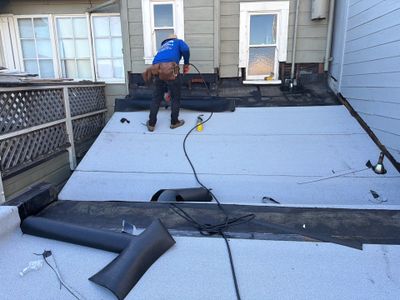
Completed
Flat roof
-
Completed
Gutters
-
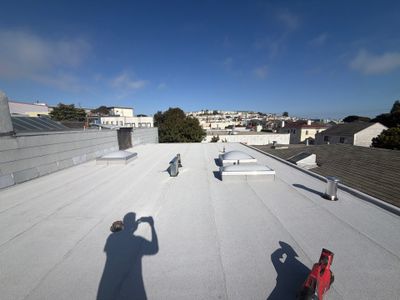
Completed
Roof replacement
-
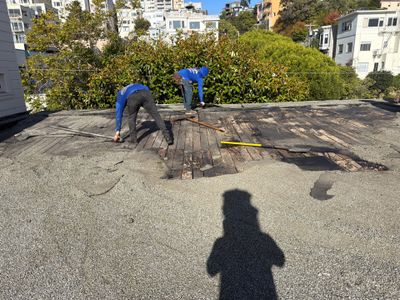
Completed
Roof replacement
How a San Francisco reroof works, step by step
A reroof in the city has more moving parts than in the suburbs: a permit, street space for the debris box, neighbors on both sides and fog that can delay a membrane install. This is the order we run it in.
-
Free inspection
We look at the roof, the attic or ceiling below, the parapets and the joints with the neighboring buildings, and photograph everything in CompanyCam.
-
Written, itemized estimate
You get a written estimate that lists the roof system, flashing, drainage, permit and street space, so you can compare it line by line. Condo and TIC buildings get one estimate for every owner to review.
-
DBI permit
We apply as the C-39 licensed contractor. A reroof that needs no plans and replaces no framing or decking can be permitted online through PermitSF; work that needs plans or new decking goes through an over-the-counter permit.
-
Street space and neighbors
The street space for the debris box and materials is requested on the reroofing application. Once the permit is issued we apply for the street space permit with Public Works, post the parking signs and let the neighbors know.
-
Tear-off and deck check
Old layers come off, and the decking is checked and photographed. If boards need replacing, we tell you before it changes the price and make sure the permit covers that work before anything new goes down.
-
New roof and inspection
We install the new roof with new flashing at the parapets, walls and penetrations, request the city inspection, clean up and send you the photo record and your warranty.
San Francisco roofing permits
San Francisco requires a permit before roofing material is installed, repaired or removed, with limited exemptions listed in Building Code Section 106A.2. Reroofing is permitted through the Department of Building Inspection, and only a C-39 licensed roofing contractor can apply online. We pull the DBI permit and request the inspections. Other city rules that often come up on SF roof jobs:
- Online or over the counter: a reroof that needs no plans and replaces no structural parts (framing or decking/sheathing) can be permitted online through PermitSF. If plans are needed or decking has to be replaced, it takes an over-the-counter building permit.
- Permit fee: the city lists the reroofing permit at $514 and up for single-family homes and duplexes and $714 and up for other buildings, plus any other fees the project triggers. It is a city fee, and it appears as its own line in our estimate.
- Street space: the street space a debris box or material staging needs is requested on the reroofing application, and its fee is included in the permit fee. Once the permit is issued, the street space permit and parking signs come from San Francisco Public Works. We handle both steps.
- Historic buildings: for a landmark building, the application needs a Planning approval letter (or SF Planning's confirmation that none is needed) and photos of the existing roof, and the city reviews it before issuing. Most flat-roof work behind a parapet is not visible from the street, but we check.
- Cool roofs and climate zone: San Francisco is in California Energy Code climate zone 3. The reroof application asks for cool-roof details on commercial buildings replacing more than half the roof or 2,000 sq ft; we check the current Energy Code rule for your building and put it in the estimate.
- Better Roofs Ordinance: since January 1, 2017, most new construction in San Francisco must put solar, a living roof or both on 15 to 30 percent of the roof. A reroof of an existing home is not new construction, but if you plan to add solar, we lay out the membrane, flashing and mounts so both can be serviced.
- Shared walls: on row houses we plan flashing at the neighbor's wall and let neighbors know before work starts.
San Francisco Department of Building Inspection (DBI) (official site) · How we handle roofing permits
Official sources
Frequently asked questions
How do I choose a roofing company in San Francisco?
Check the license on the CSLB website (roofing is a C-39 license), ask for insurance certificates, and get a written, itemized estimate. Pick a roofer who pulls the DBI permit, has real flat-roof experience on SF row houses and Victorians, and photographs the work. Read reviews on Google and Yelp, not only on the company's own site.
How do I find a top-rated roofer in San Francisco?
Start with independent reviews on Google and Yelp and read the recent ones, including the low-star reviews and how the company answered them. Look for jobs like yours, such as flat roofs on row houses or leaks at a shared wall. Then confirm the C-39 license and any complaint history on the CSLB website. Our own customer reviews are on our reviews page, and you can check our license the same way.
Are you licensed to work in San Francisco?
Yes. Alpha Eagle Roofing holds a California C-39 roofing contractor license (CSLB #1148511), is bonded and insured, and is based in the city at 1160 Battery St, Suite 100. A state license covers work in San Francisco; the permit for each job comes from DBI.
Do you pull SF permits for roof replacement?
Yes. A reroof in San Francisco needs a building permit from the Department of Building Inspection. We pull it, schedule the inspections and arrange street space for a debris box when the job needs it. The permit is listed in your written estimate.
Do you work on Victorian and Edwardian flat roofs?
Yes, that is most of our work in the city. We usually install modified bitumen or a single-ply membrane such as TPO, with new parapet flashing and drainage. The right system depends on the building, any roof deck or solar, and how the roof drains, and we recommend one in writing after the inspection.
My roof leaks where it meets the building next door. Can you fix it?
Yes. The joint between your roof and the neighbor's wall or parapet is one of the most common leak points in the city. We rebuild the flashing at that joint and tie it into your roof membrane.
Why does my Sunset or Richmond roof wear out so fast?
Fog keeps the roof damp, salt air corrodes metal, and ocean wind drives rain into every seam. Corrosion-resistant flashing, a membrane suited to ponding and clear drainage help the roof last longer.
Should I repair or replace my San Francisco roof?
Repair it when the roof is sound and the water is getting in at one detail, such as a parapet cap, a shared-wall joint, a skylight or a scupper. Replace it when water ponds across a flat roof, leaks keep coming back after patches, or there are several old layers or soft decking. After the free inspection we put the option that fits in writing, and both when both are reasonable.
How much is a reroofing permit in San Francisco?
The city lists the reroofing permit at $514 and up for single-family homes and duplexes and $714 and up for other buildings, plus any other fees the project triggers. The street space fee is included in the reroofing permit fee. The permit is its own line in our written estimate.
Do I need Planning approval to replace the roof on a historic SF building?
For a landmark building, the reroofing application needs a Planning approval letter, or SF Planning's confirmation that none is needed, plus photos of the existing roof, and the city reviews it before issuing the permit. We check the property's status before we quote and include that step in the schedule.
Does the Better Roofs Ordinance mean I need solar when I replace my roof?
The Better Roofs Ordinance applies to most new construction: since January 1, 2017 those projects must put solar, a living roof or both on 15 to 30 percent of the roof. A reroof of an existing home is not new construction. If you plan to add solar, we lay out the new roof so the panels and the membrane can both be serviced.
Can you replace the roof on a condo or TIC building?
Yes. On condo and TIC buildings the roof is usually shared property, so the HOA or all the co-owners approve the work. We inspect, write one itemized estimate everyone can review, and plan access, street space and the schedule around the residents.
More for San Francisco homeowners
- San Francisco roofing guide
- Do I need a permit to replace my roof in SF?
- How long does a roof last in San Francisco?
- How to find a licensed roofing contractor in California
- Comparing roofing quotes
- How to find the best roofer in San Francisco
- Average cost to replace a roof in San Francisco
- Is $30,000 too much for a roof?
- What is the 25% rule for roofing?
- My roof is 20 years old: should I replace it?
- Cheapest time of year to replace a roof
- Customer reviews
- Bay Area roofing permits: who pulls them
- Why Alpha Eagle Roofing
Nearby cities we serve
More Roofing Answers for San Francisco Homeowners
- What is the best flat roof system for a San Francisco house?
- Who do I call for an emergency roof leak in San Francisco, and what happens next?
- What does a free roof inspection from Alpha Eagle include?
- Should I replace my skylights when I replace my roof?
- Does San Francisco’s Better Roofs ordinance make me add solar when I replace my roof?
- What extra steps apply when reroofing a historic building in San Francisco?