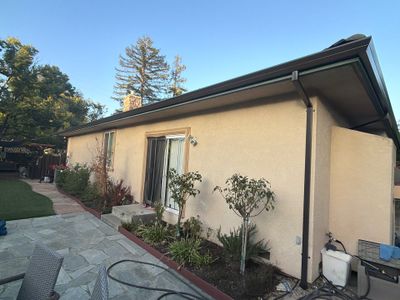
Gutter guards reduce how often gutters need cleaning; no guard makes them maintenance-free. Under heavy tree cover, on gutters that are hard or unsafe to reach, and in fire hazard zones, a good stainless micro-mesh guard is usually worth it. On an open lot with no trees overhead, a cleaning schedule is usually the cheaper answer. Alpha Eagle Roofing recommends guards only where they pay off, attaches them without lifting your roofing, and cleans and repairs the gutters before covering them.
Who this service is for
- Homes under oaks, pines, redwoods or eucalyptus that fill the gutters several times a year.
- Two- and three-story homes where gutter cleaning means tall ladders.
- Homes in fire hazard zones, where dry debris in gutters is an ember risk.
- Owners whose downspouts clog repeatedly with needles or seed pods.
When guards are worth considering
You clean more than twice a year
If the gutters fill between your fall and spring cleanings, guards usually save money over time.
Needles in the downspouts
Pine and redwood needles pack into downspouts and elbows. Fine mesh keeps most of them out.
Ladder work you would rather avoid
Tall or steep sites make every cleaning a safety question.
Fire hazard zone
Dry leaves and needles in a gutter sit right at the roof edge, where embers land.
Overflow from debris, not size
Guards help when debris is the problem. They do not fix gutters that are too small or badly pitched.
How we add guards
- Look at the trees and the gutters What falls on your roof and when, and whether the gutters underneath are sound, sized and pitched correctly.
- Clean and repair first Guards go on clean, tight, properly pitched gutters. Covering a leaking or sagging gutter just hides the problem.
- Choose the guard for the debris Fine micro-mesh for needles and small debris; we explain the trade-offs of other types for your trees.
- Attach without lifting the roofing Guards fasten to the gutter and fascia. Slipping a guard under the first course of shingles can break the seal strip and conflicts with many manufacturer instructions.
- Water test We run water over the guards to confirm it reaches the gutter rather than shooting past.
- Show you the upkeep Every guard needs an occasional brush-off. We show you what to look for and how often.
Which trees, which guard
The right guard depends on what lands on your roof. These are the patterns we see across the Bay Area.
Coast live oaks
Leaves, catkins and acorns, with the heaviest drop in spring rather than fall. Micro-mesh handles them well; leaves sit on top and dry out, then blow off or brush away.
Pines
Long needles that slip through screens and perforated covers and then mat inside the gutter. Fine stainless micro-mesh is the type that keeps most needles out.
Redwoods
Small needles and fronds that clog downspouts. Fine mesh helps; the guard surface still needs brushing after the fall drop.
Eucalyptus
Long leaves and strips of bark much of the year. Bark strips can lie across any guard, so expect to clear the surface more often than under oaks.
Open lots
No trees overhead means little debris. Guards rarely pay off; a yearly cleaning before the rains is usually enough.
What guards will not do
Guard advertising tends to skip this part.
They are not maintenance-free
Debris collects on top of every guard, and fine material (pollen, seed fluff, roof granules) still reaches the gutter. Plan on brushing the surface and flushing the gutters occasionally.
They do not add capacity
If your gutters overflow because they are too small or have too few downspouts, guards will not fix that. Sizing and outlets will.
Heavy downpours
Some cover styles, especially reverse-curve (surface-tension) covers, can let water overshoot during intense rain, particularly below steep roofs.
Bad gutters underneath
A guard on a leaking, sagging or flat gutter just makes the problem harder to see and harder to fix.
Guards in fire hazard zones
In designated Fire Hazard Severity Zones, what sits in the gutter matters.
Why it matters
Embers from a wildfire land on roofs and in gutters. Dry leaves and needles in a gutter can ignite and expose the roof edge and fascia.
What the rules say
California's wildland-urban interface building rules address debris in roof gutters on buildings they apply to. We will tell you what applies to your property.
Choose non-combustible
In fire zones, metal guards are the sensible choice; plastic guards and foam inserts can melt or burn.
Keep it clear
A guard reduces debris but does not replace clearing the roof and gutters before fire season. See roofing in Bay Area fire zones.
Gutter guard types compared
Stainless micro-mesh
Pros
- Keeps out leaves and most needles
- Lets water through quickly
- Metal: suitable in fire zones
Cons
- Higher upfront cost
- Surface still needs an occasional brush-off
- Fine debris can build up on the mesh under pines
Perforated aluminum covers
Pros
- Durable and lower cost than micro-mesh
- Stops large leaves
Cons
- Needles and small debris pass through the holes
- Harder to clean under than an open gutter
Screens
Pros
- Inexpensive
- Easy to remove
Cons
- Needles and seeds get through and mat underneath
- Plastic screens sag and degrade in sun
Reverse-curve covers
Pros
- Shed leaves well
- Solid top keeps most debris out
Cons
- Water can overshoot in heavy downpours
- Visible from the street; fit varies by roof
Foam and brush inserts
Pros
- Cheap and quick to install
Cons
- Hold debris inside the gutter
- Break down over time and can grow plants
- Not suitable in fire zones
For most Bay Area homes with trees overhead we recommend stainless micro-mesh, fastened to the gutter and fascia. We generally do not recommend foam or brush inserts.
Thanks. Your request is in.
We will text you to confirm.
Active leak? Our 24/7 emergency line is (415) 410-7917. Call now and we will prioritize your request.
Call (415) 410-7917What affects the cost
We do not publish guard prices; the guard type and the condition of the gutters underneath change the job a lot. Your written estimate is built from these factors:
- Total length of gutter to cover
- Guard type and material
- Cleaning and repairs needed before the guards go on
- Number of stories, roof height and access
- Roof edge details: valleys, corners and transitions that need custom fitting
Timeline, permits and inspection
How long it takes
Adding guards to sound, clean gutters on a typical home usually takes part of a day. If cleaning, repairs or new gutters come first, they are done in the same visit or scheduled together.
Permits and final inspection
Gutter guards do not normally need a building permit.
Warranty and photo documentation
Written warranty
Every job we do comes with a written workmanship warranty, and the roofing materials carry their own manufacturer warranty on top of that. The exact terms for your job are written into your contract before any work starts, so you know what is covered and for how long before you sign. See our warranty page for how our warranty works.
Every job photographed in CompanyCam
We document every job in CompanyCam: before photos, in-progress photos of the work that ends up hidden (decking, underlayment, flashing), and after photos. That photo record is useful long after we leave, for an insurance claim, a warranty question, or a buyer's inspector when you sell. We can share it with you on request. See finished work in our project gallery.
Your protections under California law
Check the license.
Roofing in California must be done by a contractor licensed by the Contractors State License Board. Ours is CSLB #1148511, Class C-39 (Roofing). You can look up any contractor at cslb.ca.gov.
The down payment is capped by law.
On a home improvement contract, a California contractor may not ask for a down payment of more than $1,000 or 10% of the contract price, whichever is less.
Payments should not get ahead of the work.
Progress payments are supposed to track work actually completed and materials delivered, not run ahead of them.
You have a right to cancel.
California home improvement contracts must include a written notice of your right to cancel, generally within three business days of signing (seniors get a longer window).
Everything in writing.
Scope, materials, schedule, payment schedule, and warranty belong in the written contract. We price every job from an inspection, in writing, so there is nothing to argue about later.
Frequently asked questions
Are gutter guards worth it in the Bay Area?
Under heavy tree cover, on hard-to-reach gutters, or in fire hazard zones, a good micro-mesh guard is usually worth it. On an open lot, a yearly or twice-yearly cleaning is usually cheaper. We will tell you which applies to your house.
Do gutter guards eliminate cleaning?
No. They reduce it. Debris collects on top of the guard and fine material still reaches the gutter, so the surface needs an occasional brush-off and the gutters an occasional flush.
What is the best gutter guard for pine needles?
Fine stainless micro-mesh. Needles slip through screens and perforated covers and then mat inside the gutter.
Can gutter guards void my roof warranty?
Guards that slide under the first course of shingles can break the shingle seal and conflict with the manufacturer's instructions. We attach guards to the gutter and fascia instead, without lifting the roofing.
Can guards go on my existing gutters?
Yes, if the gutters are sound, sized correctly and pitched to drain. If they leak or sag, we fix that first, or recommend new gutters if they are worn out.
Will my gutters overflow in heavy rain with guards?
A properly installed micro-mesh guard lets water through quickly. Overflow in heavy rain usually means the gutters or downspouts are undersized, which guards do not fix.
What guard should I use in a fire hazard zone?
A metal guard, not plastic or foam. And keep the roof and gutters clear before fire season, since a guard reduces debris but does not remove what lands on top of it.